
Landscape Print Sizes: How to Choose the Perfect Fit for Your Space
- Daniel Forster

- Jun 30, 2024
- 7 min read
Updated: Nov 24
One of the most common questions I get from customers is about print size. It makes sense. A print that's too small gets lost on a big wall, and one that's too large can overwhelm a room. I've helped hundreds of people figure this out over the years, so I wanted to share what I've learned.

Getting the size right matters for a couple of reasons. First, a well-sized print becomes a focal point in your room instead of an afterthought. Second, the right size means we don't have to crop the image awkwardly to make it fit. This one's important to me as the photographer. When I capture a scene, the composition is intentional, and I want you to see it the way I intended.
Here's what I've found works when choosing the right size for your space.

Measure Your Space
Start by grabbing a tape measure. Get the width and height of the wall space where you want to hang your print. Watch out for things like light switches or thermostats that might limit your options. If you're planning to hang a print above a couch or other piece of furniture, measure the width of that too. It only takes a few minutes, and it makes the whole process a lot easier.
The Two-Thirds Rule
There's a rule called the two-thirds rule that works well as a starting point. The idea is that your wall art should take up about two-thirds of the wall's width. So if your wall is 90 inches wide, a print around 60 inches wide would work well (90 x 2/3 = 60). This creates a sense of balance in the room. That said, it's a guideline, not a law. Go a bit bigger or smaller if it feels right to you.

Viewing Distance
Think about how far away you'll usually be when you're looking at the print. Bigger rooms can handle bigger prints, and smaller spaces usually need smaller ones. A formula I use is: viewing distance divided by 2. So if you're typically viewing a print from about 8 feet away, a 4-foot (48-inch) wide print would work well. This keeps the photo big enough to appreciate from across the room but not overwhelming when you're standing close. Just remember to convert feet to inches when you're shopping.
Furniture Proportions
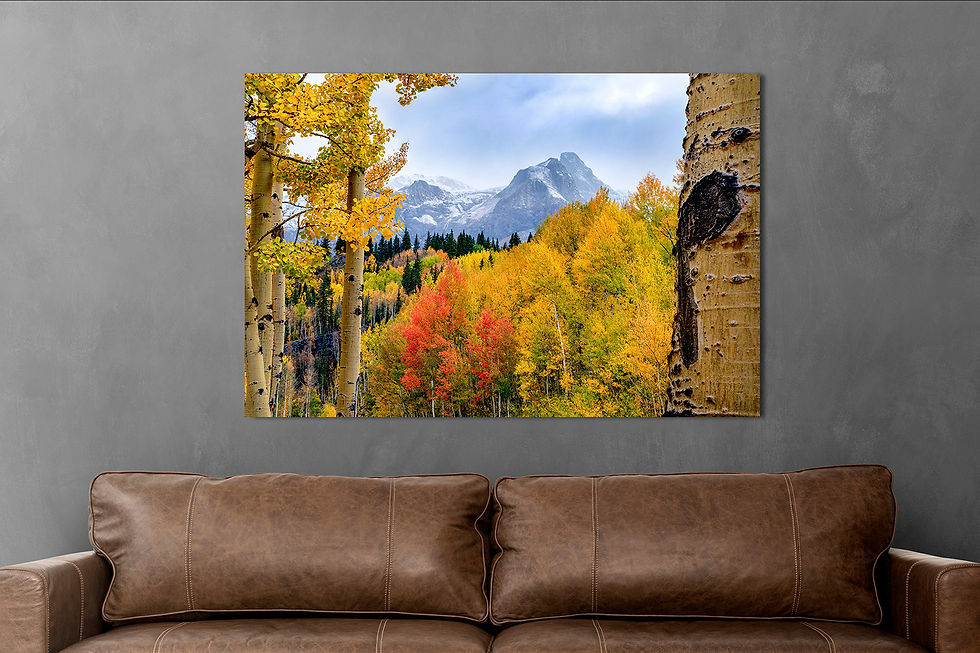
If you're hanging a print above a piece of furniture like a sofa, choose a print that's about 2/3 to 3/4 the width of the furniture below it. For a 72-inch wide sofa, that means a print somewhere between 48 and 54 inches wide. This keeps everything looking balanced.

For a more dramatic look, you could go up to 4/5 of the furniture's width. Just don't go wider than the furniture itself, or it starts to look off.4 inches wide would usually look great. This helps create a visually pleasing balance.
The Tape Trick
If you're having trouble picturing how a certain size will look on your wall, grab some painter's tape. Use it to outline the print dimensions on your wall, then step back and look at it. I tell people to leave the tape up for a day or two and live with it before deciding. It's a simple way to see what you're getting before you commit.
Ceiling Height
Ceiling height matters more than people realize. If you have high ceilings, you can go for taller vertical prints, or even a diptych (two panels) or triptych (three panels) to fill that extra wall space. For standard 8-9 foot ceilings, wider horizontal prints usually work best and help the room feel more open.

If you have lower ceilings, stick with smaller prints or arrange a few smaller ones horizontally. Large vertical prints in a low-ceiling room can make the space feel cramped.
Room Purpose
The room itself should guide your choice. Living rooms and entryways can handle bigger statement pieces since that's where you want a focal point. Bedrooms do better with calmer, smaller pieces, or a series of prints above the bed. Dining rooms work well with a larger print on one wall to anchor the space. For home offices, I'd keep the size moderate. You want something you enjoy looking at, but not something so large it pulls your attention away from work.
Gallery Walls
If one big print feels like too much, a gallery wall is another option. You group several smaller prints together, usually with a common theme or color palette. This works well for filling larger wall areas without committing to a single massive piece.

A few things that help: keep consistent spacing between prints, usually 2-3 inches. Mix different sizes if you want more visual interest. And before you start putting holes in the wall, cut out pieces of craft paper in the sizes of your prints and tape them up first. It lets you move things around until you find an arrangement you like.
Aspect Ratio
One more thing worth understanding is aspect ratio. This is just the shape of the image, how the width relates to the height. You'll see it written as numbers like 2:3, 4:5, or 16:9. A 1:1 ratio is a square. A 16:9 ratio is a wide rectangle, like a movie screen. A 2:3 ratio is somewhere in between, which is what most digital cameras produce.
Why does this matter? If you already have a frame you want to use, or you're trying to fit a print into a specific space, knowing the aspect ratio tells you what shape you're working with. Some of my prints are wider panoramas, others are closer to square. It helps to know before you order.
Current Trends
I've noticed some patterns in what people are buying lately. Oversized prints are popular right now. I'm talking 60x40 inches or larger, especially for living rooms. People want a single piece that fills the wall and grabs attention.

Panoramic prints are also selling well, which makes sense for landscape photography. A wide mountain vista or sweeping valley scene looks natural in that format. Multi-panel prints like triptychs are another option if you want to go large but have more flexibility with hanging.

On the smaller end, I'm seeing more gallery walls with minimalist arrangements. And vertical compositions are getting more attention, especially from people with tall narrow walls to fill.

Trends come and go, though. The right size is whatever works for your space and the images you connect with.
Conclusion
Everything I've covered here is just a starting point. Measure your space, use the guidelines that make sense, and trust your own judgment. At the end of the day, you're the one living with the print on your wall.
If you want to browse my work, my Portfolio is a good place to start. And if you find something you like but aren't sure about the size, reach out to me. I offer a free service where I can mock up how a print would look on your wall before you order. It takes the guesswork out of it.

Frequently Asked Questions (FAQs)
How high should I hang my landscape print?
Aim for the center of the print to be around 57-60 inches from the floor, which puts it at eye level for most people. If you're hanging it above furniture, leave about 6-8 inches between the top of the furniture and the bottom of the print.
Can I hang a large print in a small room?
Yes. A large print can actually make a small room feel bigger by drawing the eye in. Just leave some wall space around it so it doesn't feel crammed in.
What size print works best above a sofa?
Aim for about 2/3 to 3/4 the width of the sofa. For an 84-inch sofa, that's somewhere around 56-63 inches wide.
How do I choose sizes for a long hallway wall?
A series of three to five prints works well for long hallways. Pick images that share a theme or color palette, and aim for the whole group to fill about two-thirds of the wall's length. Keep the spacing between prints consistent.
What sizes work best for a gallery wall?
The overall arrangement should fill about two-thirds of the wall space. Individual print sizes can vary, but keep a consistent 2-3 inch gap between each one.
Should landscape photos always be horizontal?
No. Vertical orientation works well for scenes with tall elements like trees, waterfalls, or narrow canyons. It also fits better on narrow walls.
What's the best size for a dining room?
A print about 3/4 the width of your dining table usually works well. For a 72-inch table, that's around 54 inches wide.
Can I mix different print sizes in one room?
Yes. Mixing a larger piece with smaller ones can add visual interest. Just make sure the arrangement feels balanced overall.
What about narrow walls?
Vertical prints work well on narrow walls, or you can stack a few smaller prints vertically. Leave at least 6 inches of wall space on either side.
How do frames affect the size I should choose?
Frames add to the total dimensions. Factor in an extra 2-4 inches on each side when you're planning.
What size is best for a bedroom?
For bedrooms, aim for about two-thirds of the wall's width, or 65-75% of the furniture width if you're hanging it above a headboard or dresser. For most bedrooms, something in the 32-40 inch range is a good starting point. Calmer scenes tend to work better in bedrooms than dramatic ones.
Is there a maximum size I should consider?
There's no strict limit, but prints wider than 60 inches can be tricky to hang and may overwhelm smaller rooms. Consider the scale of your space before going that large.
Hope this helps! Feel free to reach out if you have more questions.

All content on this page was created by Daniel Forster
All rights reserved - Copyright Daniel Forster




Comments